

Apple has updated the iMac with its M6 chip, bringing faster processing, stronger graphics, and improved AI capabilities to its colorful all-in-one desktop. Announced on October 27, 2026, the new model replaces the M4 iMac introduced in 2024, with Apple skipping the M5 generation.
The five biggest upgrades are faster CPU performance, more powerful graphics, improved AI processing, faster SSD storage, and upgraded networking. Both configurations gain additional CPU and GPU cores, a Dual 16-core Neural Engine, and greater memory bandwidth.
Connectivity improves with Wi-Fi 7, Bluetooth 6, and available 2.5Gb Ethernet. However, the familiar 24-inch design remains, along with the seven color options, 4.5K Retina display, and 12MP Center Stage camera. Starting memory and storage are unchanged at 16GB and 256GB.
The M6 iMac starts at $1,499 for the two-port model and $1,699 for the four-port version. Preorders open October 28, with deliveries and store availability beginning November 6.
The upgrades differ slightly depending on whether you choose the two-port or four-port model.
| Feature | M6 four-port | M6 two-port | M4 four-port | M4 two-port |
|---|---|---|---|---|
| CPU | 12 cores | 10 cores | 10 cores | 8 cores |
| CPU architecture | 2 super + 4 performance + 6 efficiency cores | 2 super + 3 performance + 5 efficiency cores | 4 performance + 6 efficiency cores | 4 performance + 4 efficiency cores |
| GPU | 12 cores | 10 cores | 10 cores | 8 cores |
| GPU Neural Accelerators | Added | Added | No dedicated accelerator in each GPU core | No dedicated accelerator in each GPU core |
| Neural Engine | Dual 16-core | Dual 16-core | 16-core | 16-core |
| Memory bandwidth | Up to 170GB/s | Up to 170GB/s | 120GB/s | 120GB/s |
| SSD performance | Up to 2× faster, Apple claims* | Up to 2× faster, Apple claims* | Previous-generation storage | Previous-generation storage |
| Wi-Fi | Wi-Fi 7 | Wi-Fi 7 | Wi-Fi 6E | Wi-Fi 6E |
| Bluetooth | Bluetooth 6 | Bluetooth 6 | Bluetooth 5.3 | Bluetooth 5.3 |
| Ethernet | 2.5Gb included | Optional 2.5Gb | Gigabit included | Optional Gigabit |
Apple announced the M6 iMac on October 27, 2026. Preorders open on Wednesday, October 28, at:
The new iMac will begin arriving with customers on Friday, November 6, when it also becomes available in Apple Stores and through Apple Authorized Resellers. Customers can preorder through Apple’s website or the Apple Store app.

Apple
The M6 iMac retains the slim, colorful design introduced with the M1 model in 2021. It has white display bezels, a colored chin beneath the screen, and a matching stand. There is no notch.
Apple continues to offer seven finishes: blue, green, pink, orange, yellow, purple, and silver. Despite pre-launch speculation about new colors, Apple has not announced any new color options.
Dimensions and weights are unchanged from the equivalent M4 models:
| Measurement | Two-port M6 iMac | Four-port M6 iMac |
| Height | 46.1cm / 18.1 inches | 46.1cm / 18.1 inches |
| Width | 54.7cm / 21.5 inches | 54.7cm / 21.5 inches |
| Depth, including stand | 14.7cm / 5.8 inches | 14.7cm / 5.8 inches |
| Weight | 4.42kg | 4.44kg |

Apple
Both models retain color-matched Magic accessories. The two-port model includes a Magic Keyboard with a Lock key. Buyers can configure it with a Magic Keyboard featuring Touch ID and a numeric keypad. The four-port model includes a Touch ID keyboard, with a numeric-keypad version available as an option.
Both configurations offer a Magic Mouse or an optional Magic Trackpad. USB-C charging for these accessories carries over from the M4 generation.
Apple
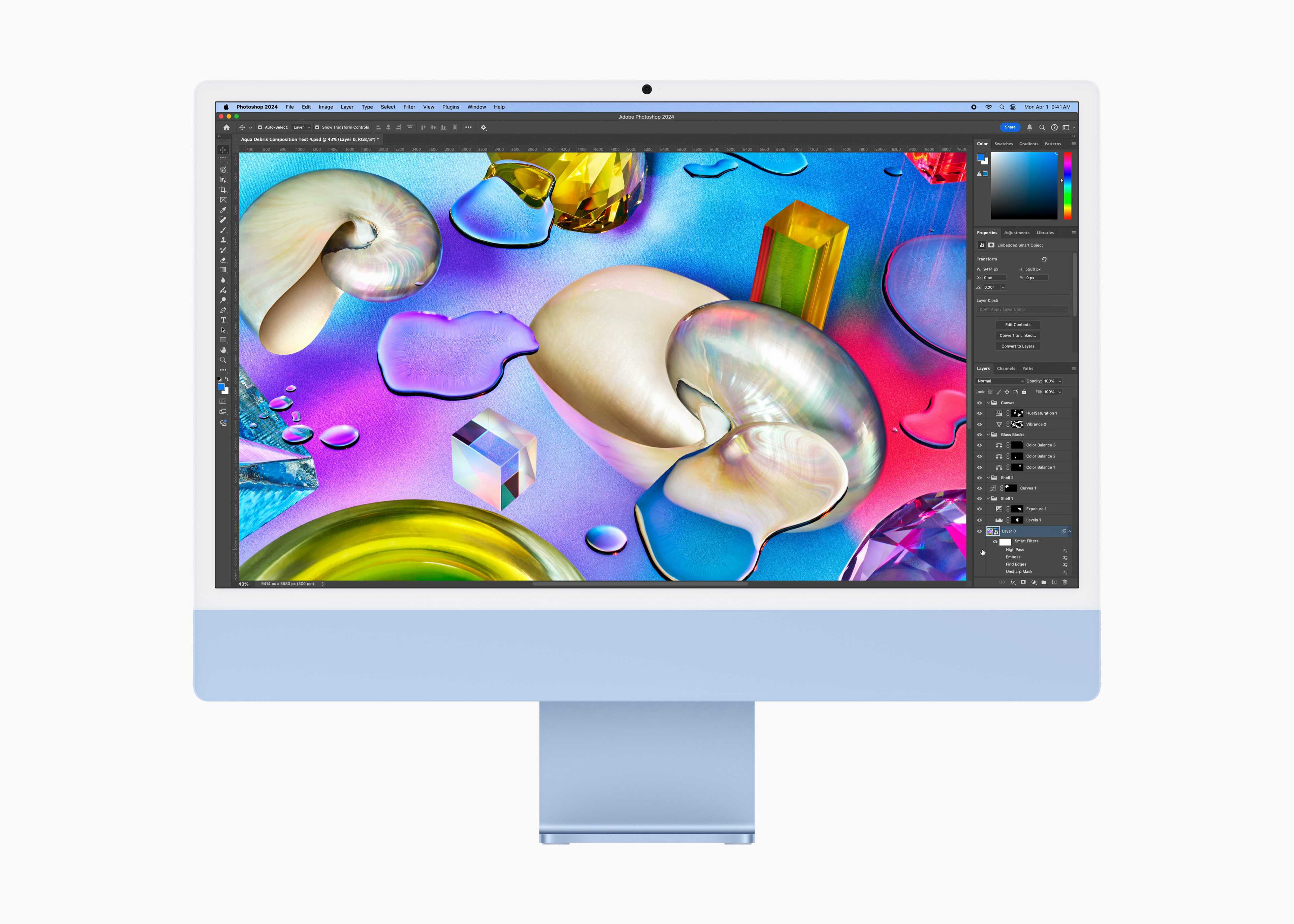
The display specifications are unchanged. Both models have a 24-inch LED-backlit 4.5K Retina display, with an actual diagonal measurement of 23.5 inches.
| Display specification | M6 iMac & M4 iMac |
|---|---|
| Resolution | 4480 × 2520 pixels |
| Pixel density | 218ppi |
| Brightness | 500 nits |
| Color | P3 wide color; support for 1 billion colors |
| True Tone | Yes |
| Nano-texture glass | Optional on the four-port model |
Nano-texture glass remains an option for reducing reflections in bright environments.
The camera and audio specifications also carry over: a 12MP Center Stage camera with Desk View and 1080p video recording, a six-speaker system with force-cancelling woofers, Dolby Atmos Spatial Audio, and a three-microphone array.
Apple
The M6 is manufactured using a 2-nanometer process, replacing the second-generation 3nm technology used for M4. The smaller process increases transistor density and helps improve performance and power efficiency.
The two-port iMac moves from an eight-core CPU and GPU to ten cores of each. That is a 25 percent increase in core counts.
The four-port model moves from a ten-core CPU and GPU to twelve cores of each—a 20 percent increase. That’s more cores, not necessarily a measured speed improvements.
Both M6 configurations introduce two super cores. The entry model pairs these with three performance cores and five efficiency cores; the four-port version has four performance cores and six efficiency cores.
Both configurations gain a Dual 16-core Neural Engine, replacing M4’s single 16-core engine. Neural Accelerators in the GPU add further processing capability for supported AI workloads.
Memory bandwidth for both M6 models increases from 120GB/s to as much as 170GB/s—approximately 42 percent higher.
Apple reports the following improvements over M4 in its specified tests:
| Workload | Claimed improvement |
|---|---|
| Productivity tasks, including Excel | Up to 1.5× |
| Graphics tasks, including Affinity photo editing | Up to 2× |
| Ray-traced gaming | Up to 2× |
| Local AI prompt processing in LM Studio | Up to 5× |
| Neural Engine AI compute | Up to 2× |
Apple identifies a 10-core M4 with 32GB memory and a 2TB SSD as its previous-generation comparison configuration.
Apple lists the same media-format capabilities across both generations: hardware acceleration for H.264, HEVC, ProRes, and ProRes RAW, plus AV1 decoding.
Memory capacities are unchanged:
| Model | Standard memory | Available upgrades |
|---|---|---|
| Two-port M6 iMac | 16GB | 24GB |
| Four-port M6 iMac | 16GB | 24GB or 32GB |
The main change is faster access to memory, rather than more included RAM.
For everyday browsing, office applications, and family use, 16GB should be sufficient. Buyers working with larger creative projects or demanding multitasking should consider 24GB. The four-port model’s 32GB option offers more headroom for memory-intensive applications and larger local AI models.
Unified memory is shared by the CPU, GPU, and other components. More capacity lets applications and local models hold more data in memory, potentially reducing reliance on SSD swap.

Apple
Both models upgrade from Wi-Fi 6E to Wi-Fi 7 and from Bluetooth 5.3 to Bluetooth 6.
Ethernet improves too. Apple’s comparison documents list optional 2.5Gb Ethernet on the two-port M6 model and include it as standard on the four-port version. Their M4 equivalents offered optional and standard Gigabit Ethernet, respectively.
The higher Ethernet connection speed can benefit transfers to compatible network storage, but requires suitable network equipment.
Apple also lists its N1 wireless networking chip and Thread support.
Port counts remain unchanged: two Thunderbolt/USB 4 ports on the entry model and four Thunderbolt 4 ports on the higher version. The 3.5mm headphone socket retains support for high-impedance headphones.
The color-matched magnetic 143W power adapter connector remains.
The M6 iMac starts at $1,499 for the two-port model and $1,699 for the four-port model, both with 16GB memory and a 256GB SSD.
Those prices match the outgoing M4 prices, but they are $200 higher than the M4’s original 2024 launch prices, which Apple increased in June 2026.
| Configuration | M6 starting price | M4 price after June 2026 increase | M4 original launch price |
|---|---|---|---|
| Two-port, 16GB/256GB | $1,499/£1,499 | $1,499/£1,499 | $1,299/£1,299 |
| Four-port, 16GB/256GB | $1,699/£1,699 | $1,699/£1,699 | $1,499/£1,499 |
The entry-level storage remains 256GB. The two-port model can be configured with 512GB or 1TB; the four-port model adds a 2TB option. These capacities match the M4 iMac.
The M6 iMac is the most compelling for buyers replacing an older Intel iMac or seeking an integrated desktop with a display, camera, speakers, keyboard, and mouse.
M4 owners have less reason to upgrade unless a particular workload is already limiting them. The screen, camera, audio hardware, memory capacities, and overall design remain familiar. Independent testing will establish how much difference M6 makes in everyday use.
Choose the two-port model for everyday home computing, schoolwork, browsing, and office applications. It receives the headline Neural Engine and memory-bandwidth improvements, so buyers do not need the four-port model simply to obtain those upgrades.
Choose the four-port model for its faster 12-core CPU and GPU, additional connections, included Ethernet, and Touch ID keyboard. It also supports 32GB memory and 2TB storage configurations.
For a flexible home-office or creative setup, our provisional recommendation is the four-port model with 24GB memory and a 512GB SSD, subject to upgrade pricing. Buyers running larger local AI models should assess whether the 32GB option meets their software’s requirements.
A substantially discounted M4 remains worth considering for everyday use. Compare equivalent memory, storage, and port configurations when judging the saving.


